Back to the modes on the home page
The eight modes, in detail.
Listening, Speaking, or Pictures with the story heard: any one of them completes the unit. Completing means you can move on, not that you already know it. The other modes train something else with the unit’s sentences, on another day; the Song brings a traditional song linked to the theme.
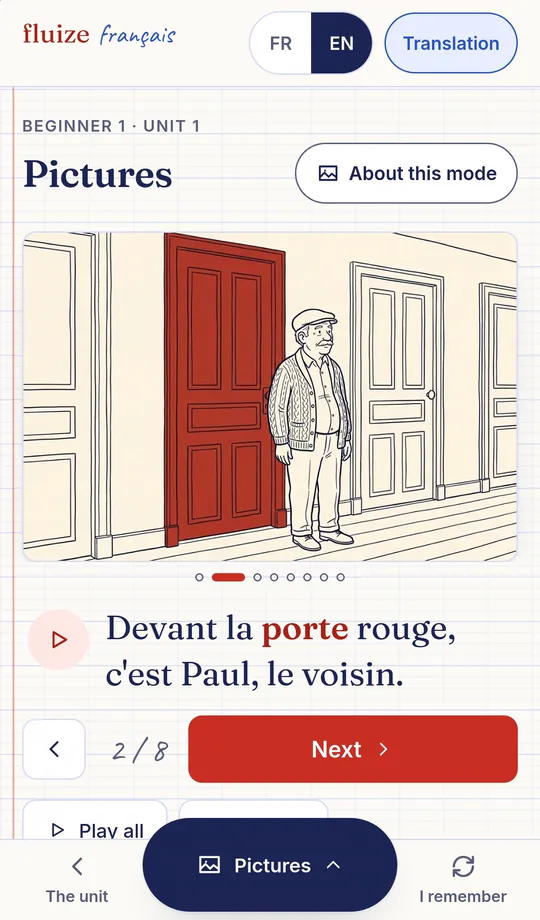
Pictures
The story in pictures, one sentence at a time.
Completes the unit once you have listened to the story
- How it works
- The story in pictures, one sentence at a time. Only the thing the sentence is about is in colour, and the translation is one tap away.
- How to use it
- Listen to each picture’s audio before you open the translation. (our suggestion)
- Look at the coloured part: the sentence is about it.
- With someone or on your own, use “Read together”: hear the sentence, answer the question out loud, then see the answer.
- What you get
- You understand the scene and connect each sentence to what it means. It is a mode for understanding; to learn to say it, use the other modes.
- When to choose this mode
- On your first contact with the unit, before any question. With someone or on your own, in “Read together”: hear the sentence and answer the simple question on the screen out loud.
- When it counts as done
- Every picture listened to once, even on different days. The dots mark the ones you have heard.
What research supports, and what it does not
In studies with single words, having a meaning aid next to the text helped people learn them, and picture plus translation helped more than translation alone.
Strength of the evidence: Medium. We found no study on drawings with a single colour.
The limit: Seeing the scene helps you understand, not speak. And the gain fades if you do not come back to the sentence on another day.
Sources. We read the abstracts of the studies, not the full texts: Ramezanali, Uchihara e Faez 2021, Shintani, Li e Ellis 2013.
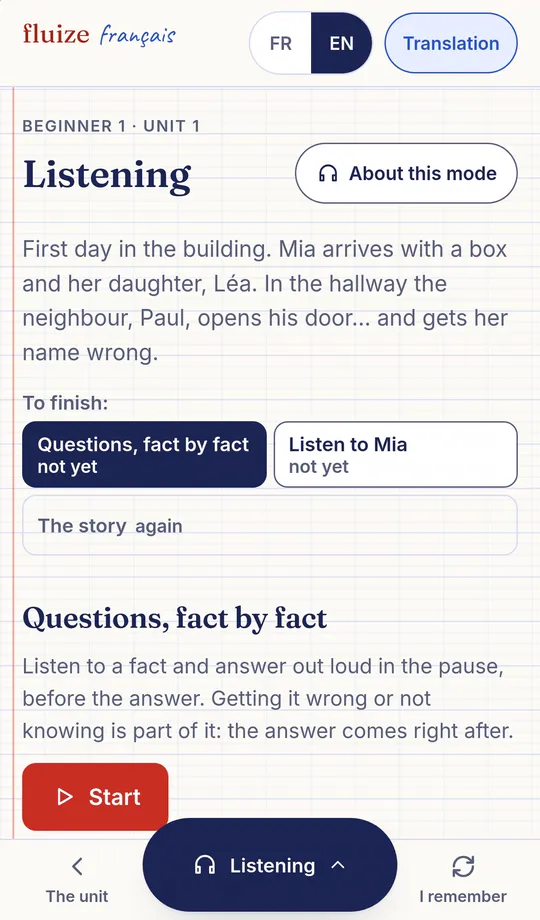
Listening
Answer fact by fact, then hear the other point of view.
Completes the unit once you answer fact by fact and hear the other point of view
- How it works
- You hear the short story one fact at a time. After each fact, you answer simple questions about it out loud, usually two (yes or no, then “this or that”); the answer only shows after a pause. At the end comes the same story told from another point of view. The whole story and the point of view stay at hand to listen to again, as often as you like.
- How to use it
- Hear one fact and answer out loud in the pause. Mistakes are part of it: the answer comes right after.
- Then hear the other point of view: the same story with one thing changed (who tells it, or when). Notice what changed.
- Come back to the whole story on another day and listen again.
- What you get
- You train your ear with a story you understand and answer out loud, in the pause, before the answer shows.
- When to choose this mode
- As a first contact or after Pictures, somewhere you can speak out loud. It is worth listening again on another day.
- When it counts as done
- Go through all the questions with Start (or Continue), letting each answer appear on its own, to the end of the story; and listen to the other point of view to the end. It can be on different days, on the same device, within 30 days.
What research supports, and what it does not
Listening to what you can understand is the basis of learning a language. In studies with words, trying to recall before seeing the answer made things stick more than restudying; applying that to a spoken question is our bet.
Strength of the evidence: Strong for remembering words. For a spoken answer to a heard question, it is our own inference.
The limit: One listen leaves little behind, and one unit has little to listen to: you need to come back to the story on other days and listen to more of the language outside the course. And the app does not listen to you: the answering practice only works if you really try.
Sources. We read the abstracts of the studies, not the full texts: Karpicke e Roediger 2008, Brown, Waring e Donkaewbua 2008.
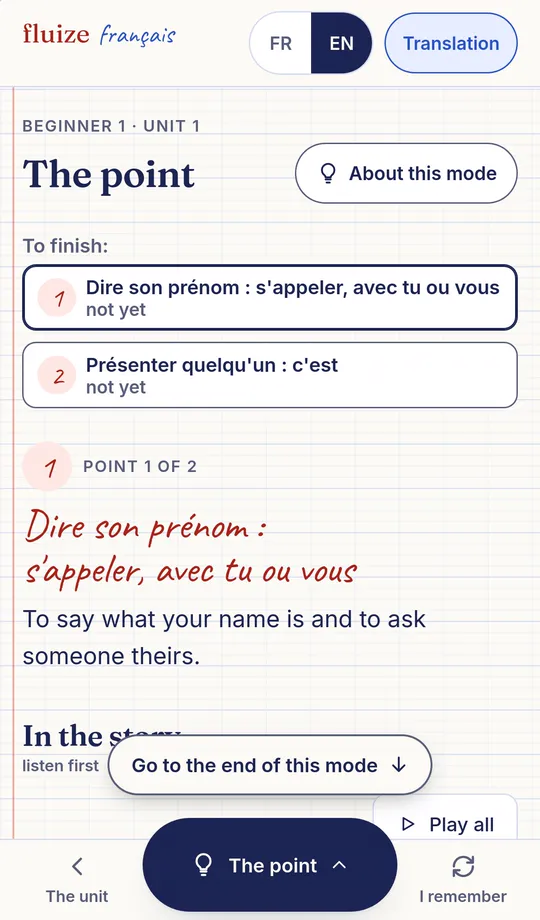
The point
The rules the story used, and why.
Does not complete the unit on its own
- How it works
- The rules the story used, one after the other, with a table and examples to listen to. Each rule stays closed until you open it. Then you hear pairs of sentences and decide what each one means.
- How to use it
- Come after you have heard the story: the examples will already sound familiar.
- Open the rule whenever you like; it is not for memorising.
- In “Listen and decide”, decide by ear before you read.
- What you get
- You learn the rules the story used and you have a place to look it up: what it is for, the table, where Portuguese or English helps and where it misleads.
- When to choose this mode
- After hearing the story, when you want to know why the sentence is that way. Or before you write a message, to check.
- When it counts as done
- Answering “Listen and decide” for each rule (for a rule without it, hearing its examples), or tapping “I finished this mode”.
What research supports, and what it does not
In studies, teaching the rule explicitly produced gains on grammar tests. Those were courses of several hours; here it is one screen to consult after you have heard the story, much less than that.
Strength of the evidence: Strong for the gain measured in courses of several hours; disputed for spontaneous speech. For one screen to consult, it is our own inference.
The limit: Knowing the rule is not the same as using it when you speak. That step takes production practice, in another mode. This mode does not complete the unit on its own.
Sources. We read the abstracts of the studies, not the full texts: Norris e Ortega 2000, Shintani, Li e Ellis 2013.
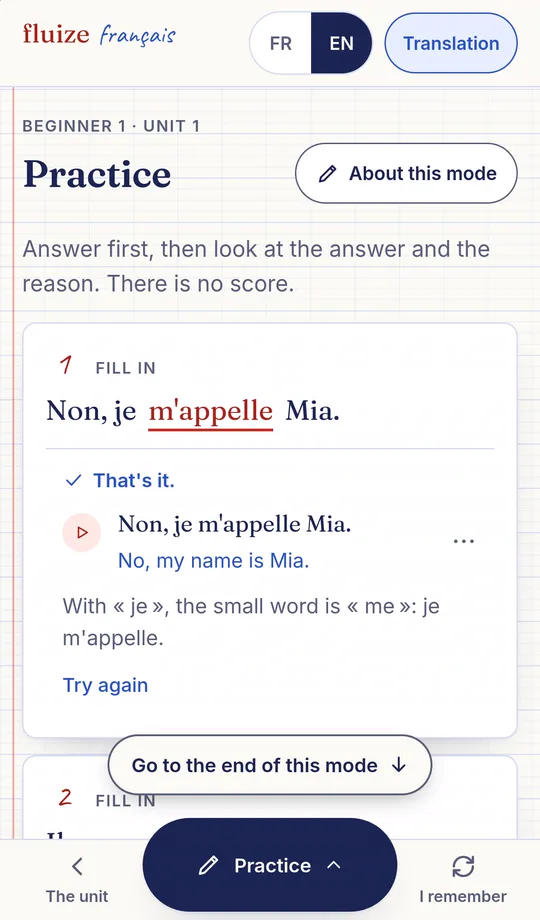
Practice
Fill in, put in order, write what you hear.
Does not complete the unit on its own
- How it works
- Fill in, conjugate, put in order, and write what you hear. You answer first; then you see the answer and one line of why. No score, no timer.
- How to use it
- Always try before you look.
- Read the why even when you get it right.
- Mistakes are part of it, and so is finding it hard: it does not mean it went wrong.
- What you get
- You build the unit’s sentences in writing, calmly, and you see the reason for each answer, even when you get it right.
- When to choose this mode
- After hearing the story or seeing the rule, when you can write without hurry. It is optional.
- When it counts as done
- Each item answered once, right or not, or a tap on “I finished this mode”.
What research supports, and what it does not
In studies, trying to answer before seeing the answer made things stick more than rereading, and a short explanation helped more than just “right” or “wrong”. That was measured with facts and words; for grammar forms it is our bet.
Strength of the evidence: Strong for remembering facts and words. For grammar forms and for these exercise types, it is our own inference.
The limit: Getting the exercise right does not guarantee getting it right when you speak. And we have no study on these exercise types as such: choosing them is our bet. It is optional, and it does not complete the unit on its own.
Sources. We read the abstracts of the studies, not the full texts: Yang et al. 2021.
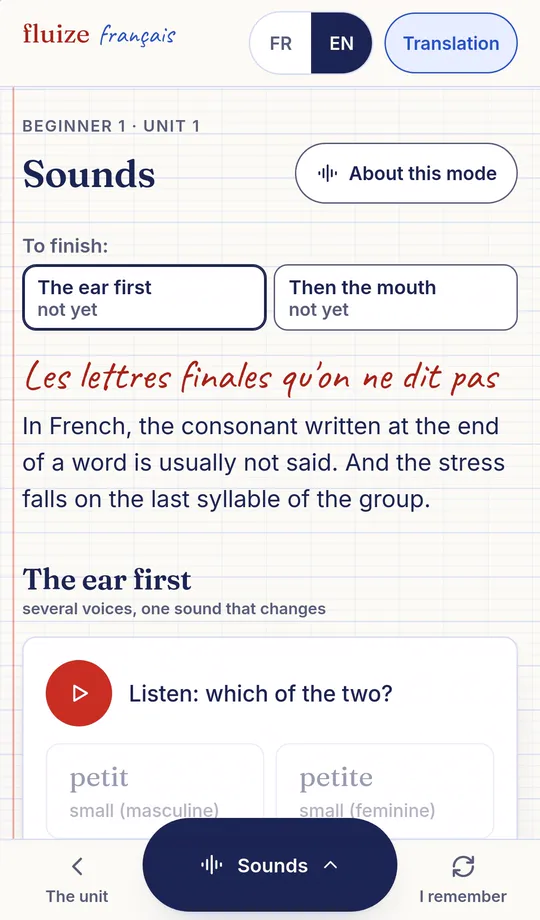
Sounds
One sound at a time: hear it, tell it apart, say it.
Does not complete the unit on its own
- How it works
- One sound per unit: you see how the mouth makes it, hear the contrast and decide which one you heard. Then you say it and record it.
- How to use it
- With headphones or somewhere quiet, decide by ear before you look.
- Then repeat it out loud and record it: here, repeating is the practice.
- Play your recording and the model; listen for what the tip points to.
- What you get
- You practise hearing one new sound of the language better. The goal is to be understood.
- When to choose this mode
- Somewhere quiet or with headphones, when two words sound the same to your ear.
- When it counts as done
- All the ear decisions and each sentence of “Then the mouth” said, or a tap on “I finished this mode”.
What research supports, and what it does not
In studies, training the ear with several voices improved how well people heard new sounds and, a little, their pronunciation. Those trainings were longer than one sound point per unit.
Strength of the evidence: Strong for the ear and medium for the mouth, with human voices and longer trainings. With generated voices, it is our own inference.
The limit: The goal is to be understood, not to lose your accent. The app does not judge your speech, and the voices are generated: the studies used human voices. When a sentence does not have its recorded voices yet, it plays in your device’s voice, and the app says so. This mode does not complete the unit on its own.
Sources. We read the abstracts of the studies, not the full texts: Uchihara, Karas e Thomson 2025, Saito e Plonsky 2019.
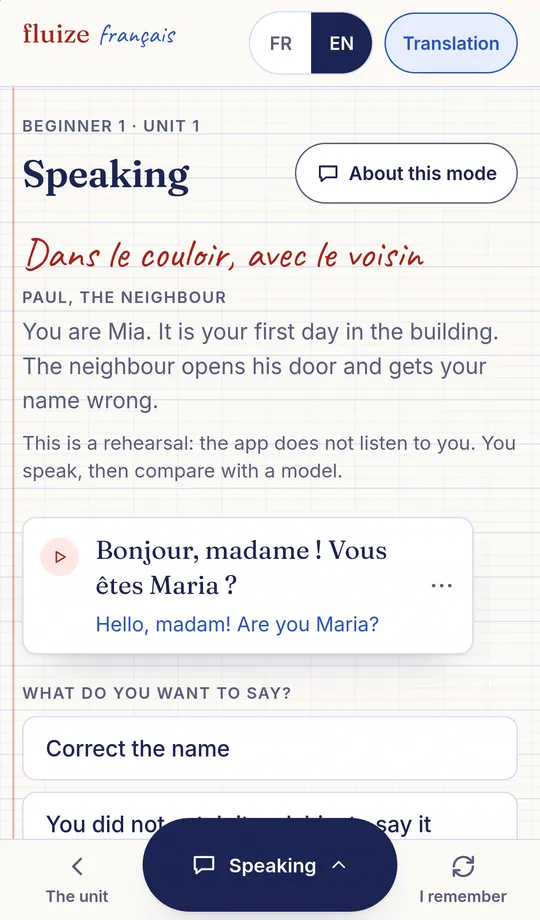
Speaking
Rehearse the scene out loud, at your own pace.
Completes the unit once you take the dialogue to the end
- How it works
- You rehearse the scene out loud, at your own pace: you choose what you want to say, say it, and hear two models. You can record and compare.
- How to use it
- Come after you have heard the story. (our suggestion)
- Really say it out loud, before you hear the models.
- If you like, record yourself and compare with the models.
- What you get
- You arrive with the sentences rehearsed. It is rehearsal: the app can record you, but it does not judge or correct.
- When to choose this mode
- The day before a real situation, like the school gate, the café or a phone call. After hearing the story, and somewhere you can speak out loud.
- When it counts as done
- The dialogue taken to the end.
What research supports, and what it does not
In two separate studies, saying new words out loud helped people remember them, and repeating the same talk kept speech smoother. For rehearsing a dialogue as such we found no study: it is our bet.
Strength of the evidence: Medium for words; weak for rehearsing a dialogue, for which we found no study.
The limit: It is rehearsal, not conversation: the app does not listen to you or correct you. What research shows most strongly is talking with someone who answers back.
Sources. We read the abstracts of the studies, not the full texts: Icht e Mama 2022.
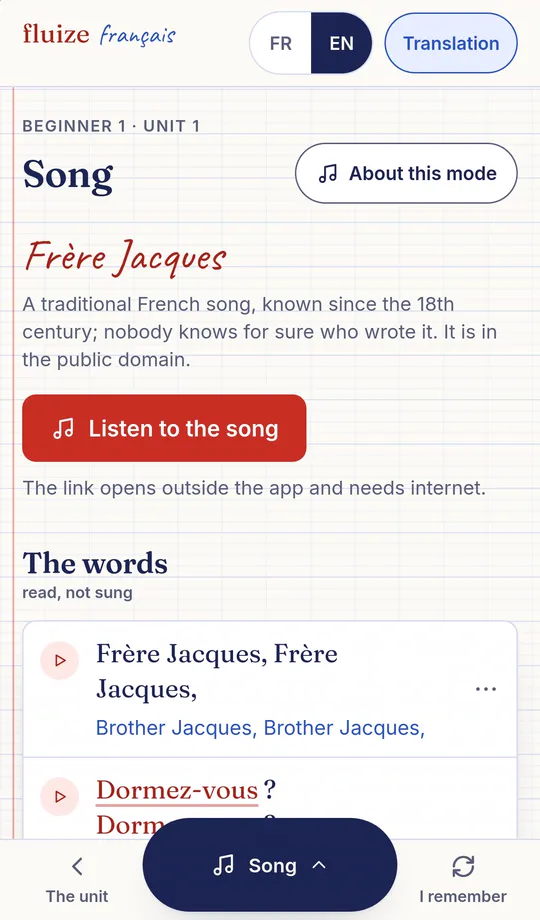
Song
A traditional song, with what it shares with the unit.
Optional, does not complete the unit
- How it works
- A traditional song tied to the theme, with what the lyrics share with the unit highlighted. The lyrics include words the unit does not teach, and the app tells you so.
- How to use it
- Come after another mode, as a break.
- Listen through the link and sing along, several times, with someone if you can. (our suggestion)
- Notice what the song shares with the unit.
- What you get
- One more encounter with the language, through sound and rhythm. It is optional.
- When to choose this mode
- In the units that have a song, after the other modes, as a break. Or with a child, to sing along.
- When it counts as done
- Every line heard, or a tap on “I finished this mode”.
What research supports, and what it does not
In some studies, singing helped people remember phrases and sound better in a new language. And people who like a song tend to repeat it (our own inference).
Strength of the evidence: Weak. There are few studies, and they disagree.
The limit: The research disagrees: in one study, singing made the lyrics harder to recall. And the studies had people listen and sing; here, today, you get the lyrics, read in a speaking voice, and a link to the song. It is one more encounter, optional, and it does not complete the unit.
Sources. We read the abstracts of the studies, not the full texts: Ludke, Ferreira e Overy 2014, Racette e Peretz 2007.
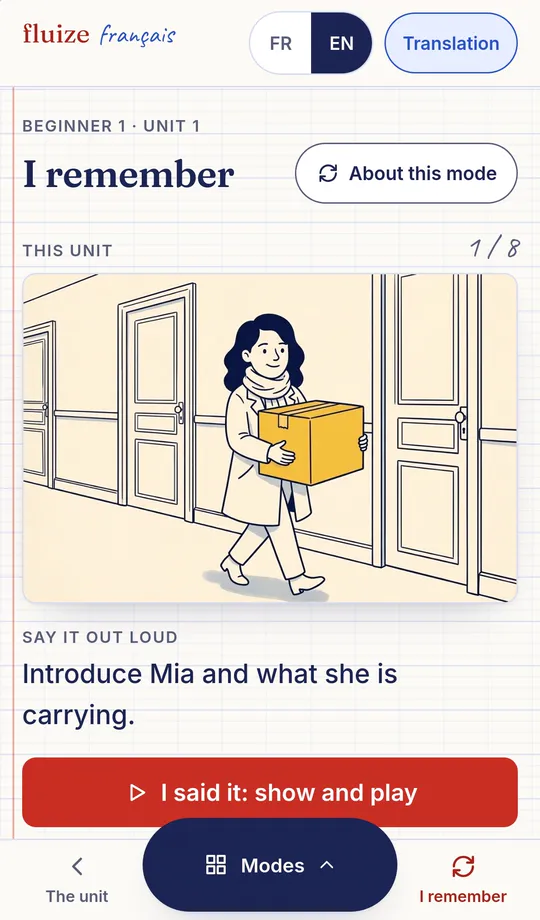
I remember
The picture comes back without the sentence: say it, then check.
Does not complete a unit: it is the return, on another day
- How it works
- Days later, the picture comes back without the sentence. You say the sentence out loud, tap, and check. No score: you are the one who says whether you remembered.
- How to use it
- Come on the day the sentences come back. It takes a few minutes.
- Say the sentence out loud before you tap.
- Not remembering is part of it: seeing the answer after trying also teaches.
- What you get
- You meet the sentences again on another day and try to recall them before you look. It is the return of a unit you have already studied.
- When to choose this mode
- On the days the app brings the pictures back, with a few minutes to spare. Not on the same day you studied the unit.
- When it counts as done
- Today’s cards answered.
What research supports, and what it does not
Trying to recall, on spaced-out days, combines the two ways of studying with the strongest evidence: in studies, it did more than rereading or repeating everything on the same day. That was measured with words and facts.
Strength of the evidence: Strong for words and facts. For whole sentences said out loud, it is our own inference.
The limit: For whole sentences said out loud, it is our bet. The days when the picture comes back are our choice, and it only works if you try before you look. It does not complete a unit: it is the return of a unit you have already studied.
Sources. We read the abstracts of the studies, not the full texts: Latimier, Peyre e Ramus 2021.
Completing the unit with a single mode is our decision, not a research finding. Among ways of studying, the one with the strongest evidence is coming back to the same content on another day and trying to recall it; that was measured with words and facts.
How we read the strength of the evidence
- Strong
- many studies, with material and people like ours.
- Medium
- there are studies, but far from our case: children, a lab, another language.
- Weak
- a few small studies, or results that disagree.
Even what is strong was measured in conditions that are not those of our app.